During Black Week last year, the customer service manager at one of Sweden’s fastest-growing e-commerce companies sat there with a look of panic on his face. Even though they had doubled their staff ahead of the season, wait times were over three hours. This is exactly where the traditional model of customer service breaks down. When your growth requires you to hire staff at exactly the same rate as sales increase, you’re not building a scalable company. You’re building a cost shock.
Company X realized that it needed to break the linear relationship between the number of orders and the number of support staff. They needed a solution that not only responded faster, but actually understood their products, their return policy, and their unique tone of voice. The solution was to implement an AI agent from ZyndraAI, trained entirely on their own data. The result was a 40% reduction in support costs during their busiest sales period, while customer satisfaction actually increased.
From reactive firefighting to proactive control
For most decision-makers in e-commerce and SaaS, customer service is often about managing volume. They look at average response times and the number of resolved cases per hour. But the real challenge lies in maintaining quality when pressure suddenly increases. Company X had previously relied on temporary staff during peak periods, which led to inconsistent quality and long training periods. Each new employee needed weeks to understand the product range and internal processes.
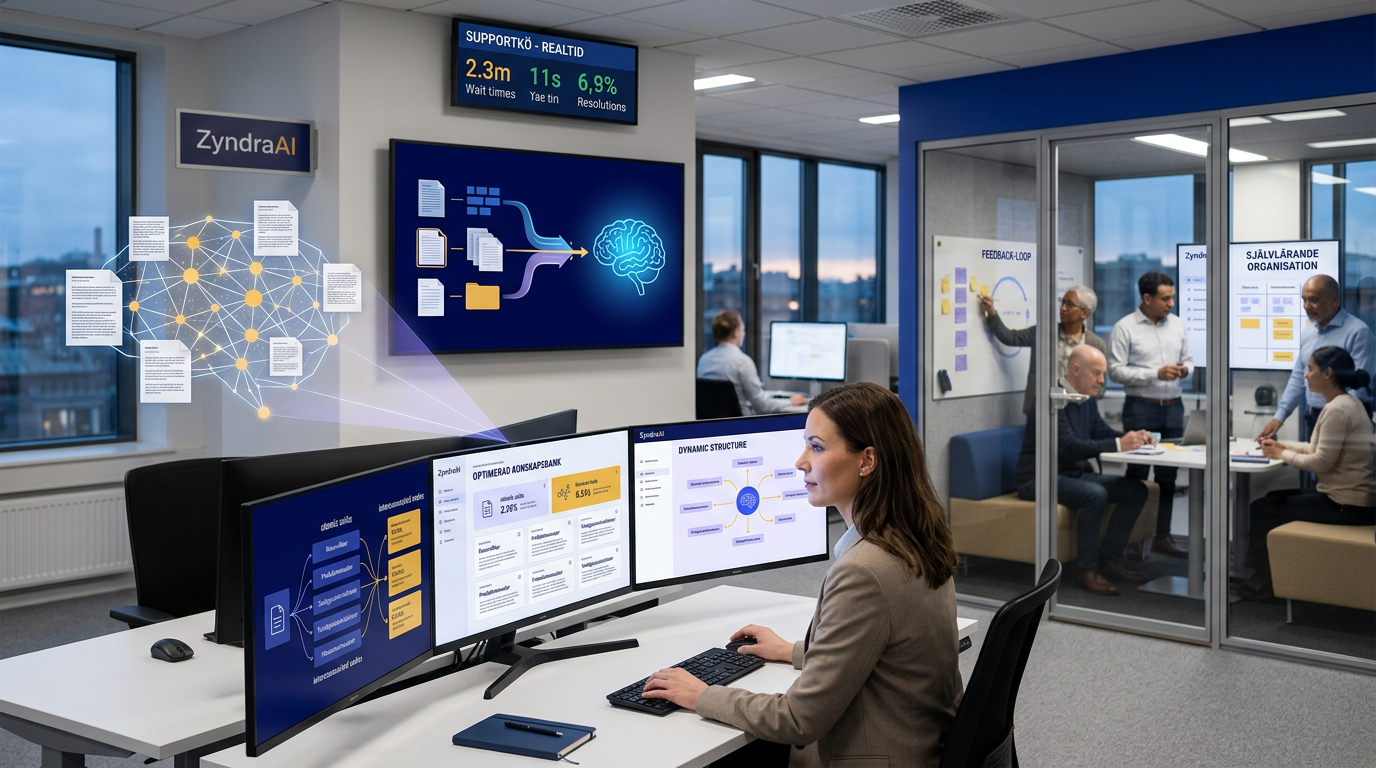
By building a digital brain based on the company’s existing knowledge base, past support cases, and product descriptions, they were able to create an expert that never sleeps. This AI agent wasn’t just a chatbot that directed users to FAQ pages. It became an active part of the team capable of handling complex questions on everything from delivery times to specific product attributes. It’s about using generative AI in a way that feels natural to the customer, not like talking to a machine.
The Power of Training with Your Own Data
The difference between a generic AI and one that actually delivers value lies in the information it has access to. Company X chose to use our no-code platform to connect its documentation directly to the AI model. This meant that their AI agent knew exactly what applied to their specific campaigns and shipping terms.
When a customer asked, “Where is my package?” or “Will this jacket fit if I’m 6’1”?”, the agent could respond immediately based on real-time and historical data. This eliminated the need for a human to manually look up the information. For Company X, this meant that 70% of all incoming cases could be resolved entirely without human intervention. The remaining 30%, which often required deeper empathy or complex troubleshooting, were seamlessly routed to human support.
This combination of AI and live human chat is the key to modern customer service. We see that the most successful companies are those that dare to let go of simple routine tasks and instead allow their staff to focus on the issues where they can actually make a difference. This creates a better work environment for staff and a faster experience for the customer.
Scalability without losing its soul
A common concern among Swedish companies is that automation will make their brand seem cold and impersonal. Company X shared this concern. They have spent years building a distinctive voice and a close relationship with their customers. That’s why it was crucial that their AI agent not only provided accurate answers, but did so in the right tone.
Since ZyndraAI is a Swedish platform, we understand the nuances of the Swedish language and Swedish business culture. We have optimized our models to handle natural conversations that don’t sound robotic. For Company X, this meant they could offer support in over 90 languages with the same high quality, which was a prerequisite for their international expansion. They were able to enter new markets without having to recruit local support teams in every country right from the start.
The economics behind a 40% savings
How do you justify an investment like this? For Company X, there were three main factors:
- Reduced staff turnover and recruitment costs: By automating the most repetitive tasks, the workload on the support team was reduced. Staff became more engaged when they were able to focus on solving more complex problems, which led to lower turnover.
- Faster customer service: Every second a customer waits is a risk of lost sales. By providing real-time responses around the clock, conversion rates increased even when the office was closed.
- More efficient use of resources: During campaigns, they no longer needed to hire expensive consultants. The AI agent automatically scaled up to handle 10,000 questions just as easily as 10.
When we looked at the figures after six months, we saw that the cost per resolved case had dropped dramatically. It’s not about cutting costs for the sake of it, but about optimizing operations to meet future demands. Non-linear scalability is the only way forward for companies that want to grow profitably.
The Way Forward for Your Organization
If you find yourself in a situation where support costs are eating into your margins, it’s time to rethink your approach. The question is no longer whether to implement AI, but how quickly you can do so safely and effectively. Building your own digital brain isn’t a project that has to take months. With the right tools, it’s a matter of days or weeks.
Company X started by identifying its top 10 most time-consuming issues. They trained their AI agent on these specific areas and saw results immediately. This gave them the confidence to roll out the solution across the entire organization. Today, their AI agent is a central part of their growth strategy, not just a support tool.
The great thing about generative AI is that it gets smarter with every interaction. Every time a customer asks a question, the system learns more about what customers are actually wondering about. This insight is invaluable for product development and marketing. You get a direct line to customer needs, filtered and analyzed in real time.
Reducing costs by 40% is entirely possible if you stop viewing customer service as a necessary evil and start seeing it as a technical asset. The future belongs to those who build smart systems that work alongside people, not in place of them. That’s how you create customer experiences that truly impress, no matter how much you grow.
Your data is your greatest asset. Use it to build something that makes a difference for both your bottom line and your customers. It’s time to bring your customer service up to speed with the rest of your business.
.png)

Sign up for our newsletter
Insights, lessons, tips and news on generative AI for customer service